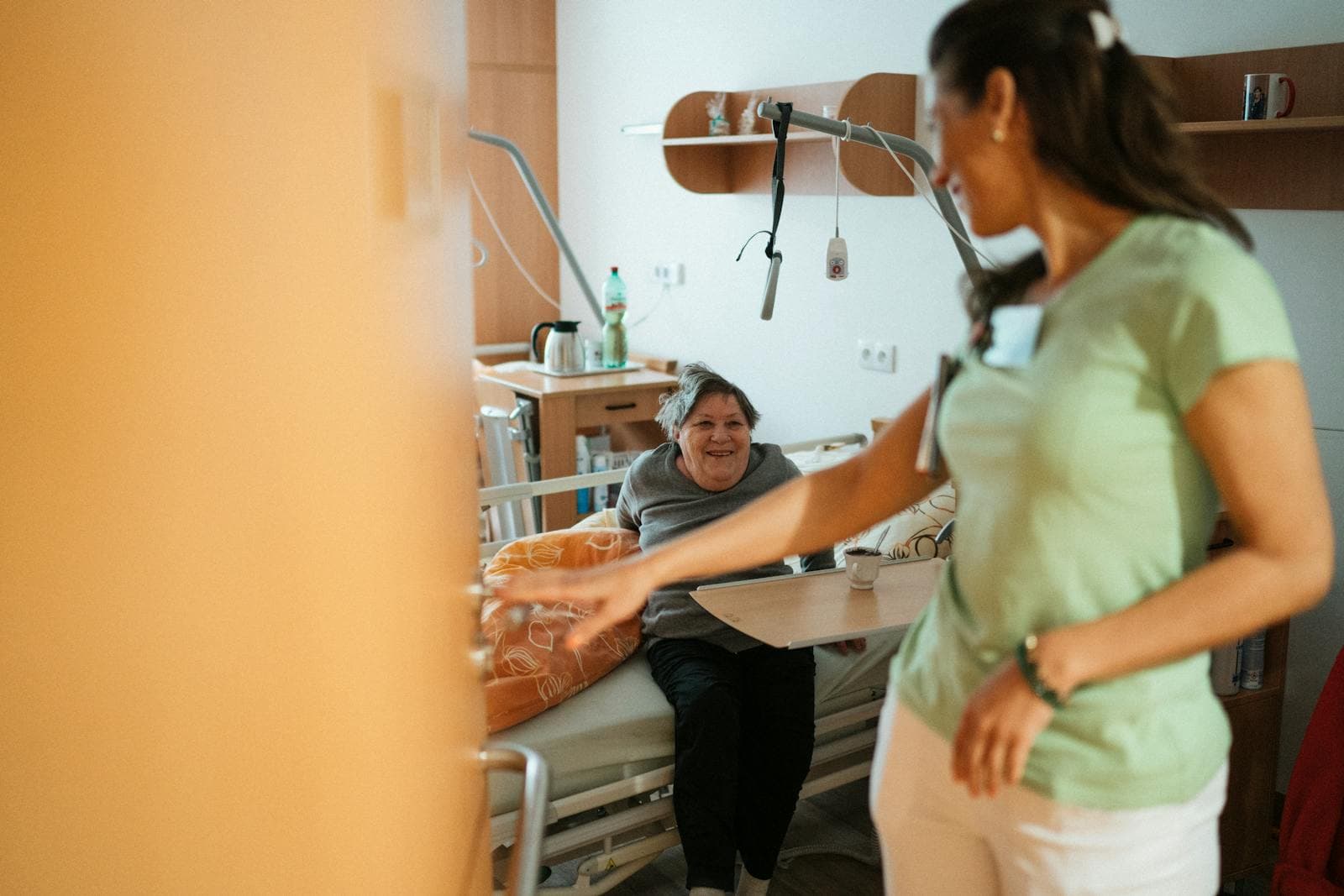
Live-in care is one caregiver in the home 24 hours with an 8-hour sleep window — best for seniors who sleep through the night. Shift care is 4 to 12 hour visits scheduled around specific needs — best for partial-day support. 24/7 awake care is three 8-hour shifts a day with all caregivers awake and active — best for seniors needing overnight hands-on care or constant supervision. Costs run from $2,000 a month (limited shift care) to $26,000 a month (24/7 awake care) in 2026.
This guide walks through each model in detail, when it’s the right fit, and the cost differences. For the broader picture, read our pillar what is 24-hour home care.
Live-in care
One trained caregiver lives in the home for 5 to 6 consecutive days, providing 16 active hours of care daily with a legally required 8-hour sleep window. A relief caregiver covers the days off.
Best for:
- Seniors who reliably sleep through the night
- Companionship plus light-to-moderate ADL needs
- Families wanting consistency with a single primary caregiver
- Budgets in the $9,000 to $14,000 per month range
Not appropriate for:
- Seniors needing hands-on overnight care (toileting, repositioning, hourly checks)
- Wandering risk or severe sundowning
- Constant medical monitoring needs
The caregiver needs a private bedroom and bathroom access. The 8-hour sleep window is legally protected — non-negotiable unless the family pays additional overnight care.
Shift care
Caregivers work scheduled 4 to 12 hour shifts based on the senior’s needs — morning shift for personal care and breakfast, evening shift for dinner and bedtime, overnight shift if needed.
Best for:
- Seniors who are safe alone for parts of the day
- Families bridging family-provided care with paid care
- Specific time windows (overnight only, weekend only, evenings only)
- Budgets that can flex from $2,000 to $10,000+ per month depending on hours
Most families start with shift care and scale up as needs grow. Common schedules: 4 hours daily (~$3,200/mo), 8 hours daily (~$6,400/mo), 12 hours daily (~$9,600/mo). Hourly rates run $25 to $40 with premiums for evenings, weekends, and holidays.
24/7 awake care
Three rotating caregivers cover 8-hour shifts; all are awake and active for their entire shift. No sleep window built in.
Best for:
- Seniors needing hands-on overnight care (frequent toileting, repositioning, medication, monitoring)
- Advanced dementia with sundowning or wandering
- Post-discharge with high complication risk
- End-of-life care at home
- Budgets in the $18,000 to $26,000 per month range
Important: The three caregivers should be on a rotating schedule so 4 to 6 trained caregivers know the case — not strangers cycling in. Consistency within the rotating roster is what separates good 24/7 awake care from bad.
The cost math, side by side
| Model | Hours covered | Monthly cost (2026) | Typical use |
|---|---|---|---|
| Shift care, 4hr/day | 120 hours/mo | $3,000–$4,800 | Partial-day support |
| Shift care, 8hr/day | 240 hours/mo | $6,000–$9,600 | Companion + ADLs daytime |
| Shift care, 12hr/day | 360 hours/mo | $9,000–$14,400 | Daytime + evening coverage |
| Live-in care | 24hr/day with sleep window | $9,000–$14,000 | Constant presence, sleeps OK |
| 24/7 awake care | 24hr/day all awake | $18,000–$26,000 | High-acuity, overnight hands-on |
How families combine models
Many families layer multiple models. Common patterns:
- Family caregiver + shift care — family covers evenings and overnight; agency covers daytime hours. Cheapest sustainable model for families with capacity.
- Live-in plus extra night shifts — primary live-in caregiver during the day with an overnight aide for hands-on needs.
- 24/7 awake transitioning to live-in — post-discharge or post-fall stabilization at 24/7, scaling back to live-in once the acute period passes.
- Hospice + 24/7 awake — Medicare hospice covers RN and aide visits; family adds 24/7 awake care for hands-on needs Medicare doesn’t fund.
When to compare against facility care
If the math on 24/7 awake care is approaching $24,000+ per month, compare against local memory care facilities (averaging $7,000 to $9,500/month) and skilled nursing facilities (averaging $8,500 to $11,000/month). At some point the home becomes the more expensive option, and the same care is delivered in a facility setting at a fraction of the cost. The non-financial considerations (familiarity, family proximity, dignity) still matter — but the math should be honest.
What’s the next step?
A free 30-minute call with a care coordinator will model the right staffing pattern for your situation — likely a combination, not a single model. Talk to a 24HomeCareNearMe advisor when you’re ready.


